
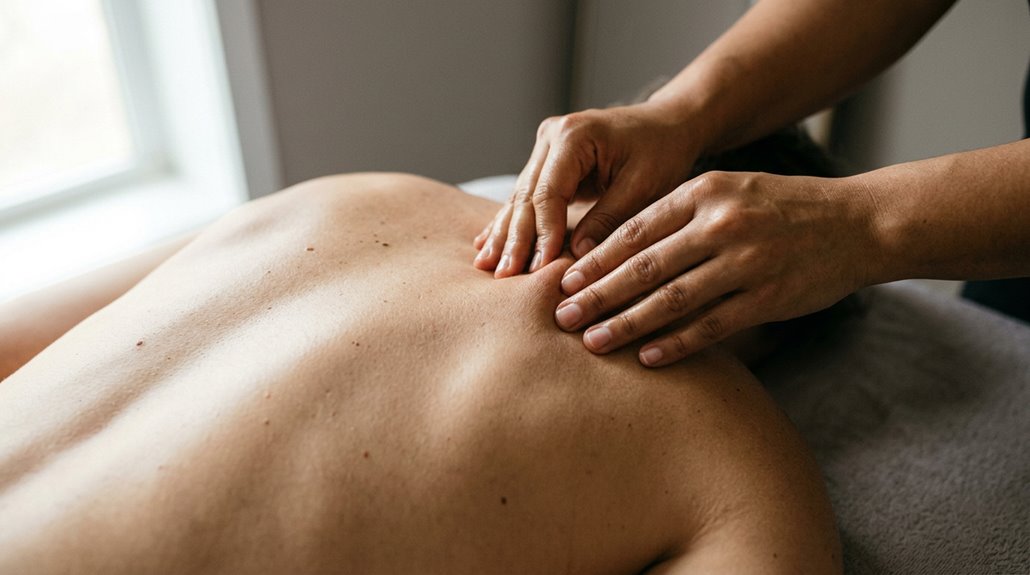
That knot between your shoulder blades isn’t just tension—it’s your body sending an urgent signal you’ve been ignoring for weeks, maybe months. Hunching over your desk didn’t help. Neither did that old injury you thought had healed. Now it sits there, tight and unyielding like a fist wedged between your shoulders, refusing to budge no matter how many times you stretch or roll your neck. Here’s what most people get wrong about treating it—and why the fix might be far simpler than the pain suggests.
Because your body keeps score of every heavy box you lift and every sudden reach you make, those tight bands between your shoulder blades don’t appear out of nowhere.
Muscle strain and overuse show up when you push harder than usual, and your fibres respond by clenching tight, like a fist that forgot how to open. This happens because your body functions as an interconnected fascial web rather than a collection of isolated muscles, so tension in one area can pull and strain the tissue between your shoulder blades.
Push past your limit, and your muscles clench like a fist that forgot how to open.
Then there’s poor posture and sustained positions—the quiet culprit behind your desk.
Hours of rounded shoulders and forward-leaning focus slowly pull your upper back into a fixed, achy shape. Your muscles start guarding, bracing against gravity instead of moving with it.
None of this means you’re broken.
It means your tissue is asking for attention, hydration, and movement to remember its natural, open shape again. If the tightness doesn’t ease up or feels unusually severe, it’s worth getting checked out, since persistent pain can sometimes point to an underlying issue that needs a doctor’s attention.
Grab a heating pad and give those knots 15–20 minutes of warmth—think of it like coaxing a clenched fist to finally uncurl. That gentle heat sinks into tight fascia like water into a dry sponge, softening the grip between your shoulder blades. Once you’re warm, press into the sore spot with a massage ball. This is trigger point therapy in its simplest form, and it’s how you relieve upper back knots fast. These stubborn knots often form due to poor posture or repetitive motions that strain the muscles over time.
| Method | Duration | Feeling |
|---|---|---|
| Heat | 15–20 min | Melting, loosening |
| Pressure hold | 10–20 sec | Release, relief |
| Deeper hold | Up to 90 sec | Unwinding tension |
| Movement break | 1–2 min | Freedom, ease |
Move afterwards. Your body craves motion, not stillness—let it breathe again. If knots keep returning despite your best efforts, a physiotherapist trained in Myofascial Activated Posture techniques can help uncover and address the deeper postural causes behind the tension.
Something magical happens when you finally give those crunched-up muscles permission to lengthen instead of just poking at them.
These stretches invite real fascia release, easing that fabric of connective tissue that’s been gripping your shoulder blades like a too-tight jumper.
Start with thoracic flexion: clasp your hands, round forward, and feel your upper back blossom open.
Follow with a cross-body shoulder stretch, gently pulling one elbow across your chest until your shoulder blade sighs with relief.
Add shoulder blade squeezes, pretending you’re holding a pencil between them, then melt into an open-chest doorway stretch to unzip your chest like an old wetsuit. For best results, hold each of these stretches for 15 to 30 seconds.
Finish with upper-back rotation and reach, threading and twisting until your spine remembers how effortless movement feels. If knots persist despite consistent stretching, a private physiotherapy assessment can offer a tailored home exercise plan to address the root cause.
Those stretches work wonders for the everyday knots that build up from hunching over a keyboard, but let’s be honest with each other for a moment: not all upper back pain is the same, and no amount of doorway stretching should mask a signal your body’s sending for help.
Listen closely if pain lingers past a week, worsens over time, or turns into a chronic ache you’re carrying at the three-month mark. Numbness, tingling, or new weakness in your limbs? That’s your nervous system waving a flag, not your fascia asking for a stretch.
Sudden severe pain, trauma, fever, or chest tightness alongside shoulder blade pain deserves urgent care. Loss of bladder control is another sign of a possible nerve or spinal cord issue that needs immediate medical evaluation.
For genuine upper back pain relief, pair professional guidance—like physical therapy Pretoria offers—with your movement practice, so your body heals safely and completely. A thorough fascial suit assessment can pinpoint exactly which movement restrictions are contributing to your pain, giving you a clearer path to lasting relief.
Tension between the shoulder blades sometimes comes with nerve-type symptoms in the arms or back, so our guide to gentle nerve flossing is worth reading next. Upper back knots and a stiff neck also tend to travel together, which we cover in how to fix a stiff neck and shoulders. The firm red peanut ball sits on either side of the spine, so it reaches the muscles between the shoulder blades without pressing on the bones.