Type “MAP exercise” into Google and you might get a lecture on blood pressure, a pricing policy or a hiking app. Confusing, right? Here’s the plot twist: in the movement world, MAP stands for Myofascial Activated Posture. It’s a gentle, breath-led way of moving that works on your fascia (the connective tissue web that wraps every muscle) to help you stand taller, move more freely and feel less stiff.
This guide is your friendly map to MAP (sorry, we had to). You’ll learn what a MAP workout means in practice, what happens in a typical session, and how to do 12 foundational MAP movement exercises at home. You’ll also find a simple two-week starter schedule and honest answers to the questions people ask us most, like “Is it safe with a bad back?” and “How long until I notice a difference?”
The short version
In this guide
Most traditional exercise treats the body like a set of separate parts: work the biceps, stretch the hamstrings, strengthen the core. MAP looks at the body as one connected web. Your fascia links muscles into long chains, so tension in one area can show up somewhere else. A stiff upper back can contribute to a sore neck, and tight calves can make bending forward feel like a struggle.
MAP movement exercises combine three ingredients:
If you’d like the full background, read what MAP movement is and how it works, or learn more about Myofascial Activated Posture at our Pretoria studio.
Did you know?
Fascia is rich in sensory nerve endings, which is part of why slow, mindful movement can change how your body feels so quickly. Researchers describe it as a continuous, three-dimensional web running through the whole body (fascia research review).
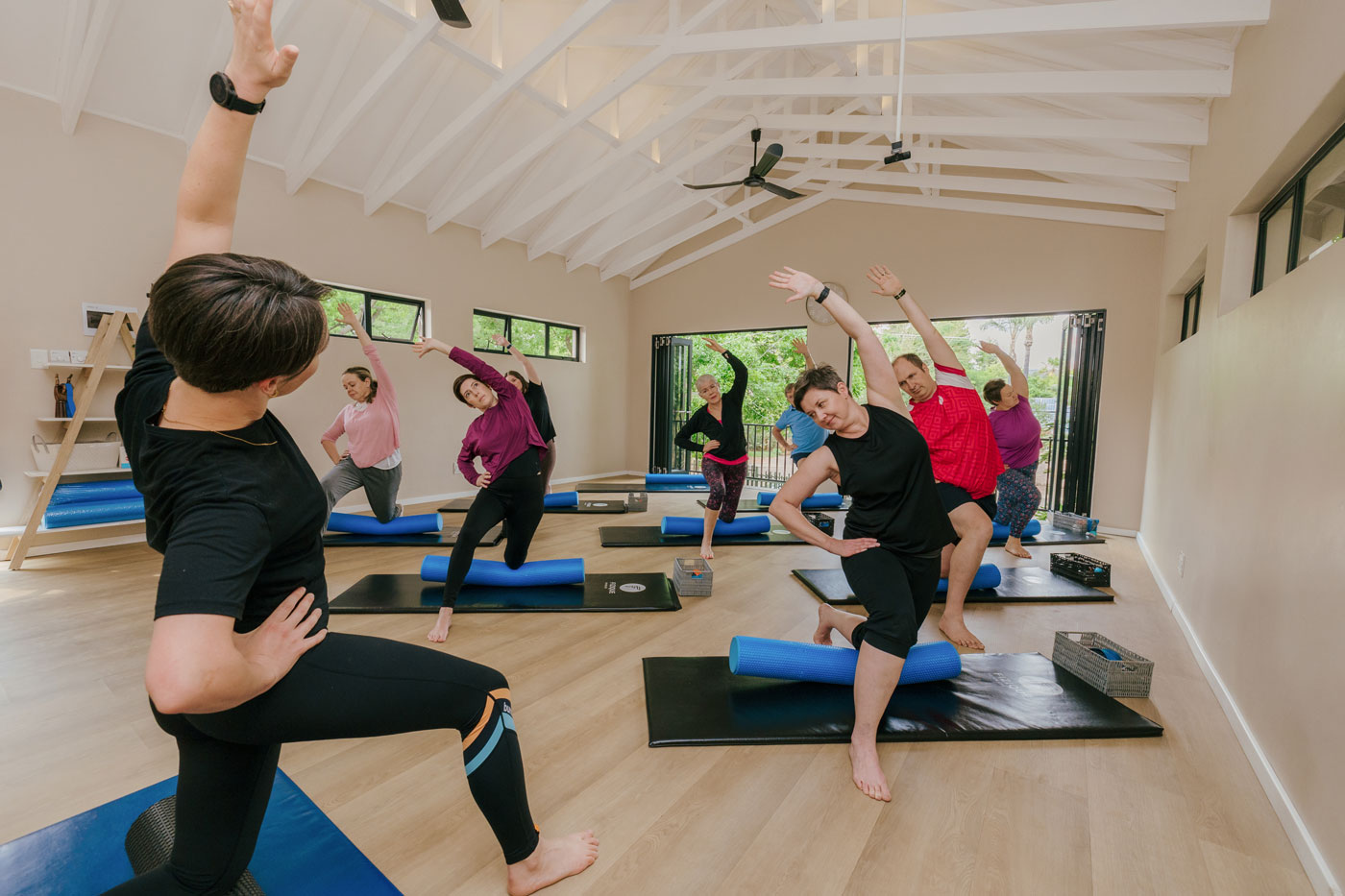
When people search for “MAP workout meaning” or “MAP workout definition”, they usually want to know one thing: what will I actually be doing? Here’s the anatomy of a typical session. In our studio classes this takes about an hour, but you can shrink it to 20 to 30 minutes at home.
| Phase | Time (studio class) | What you do | Why it matters |
|---|---|---|---|
| 1. Arrive and breathe | 5 to 10 min | Lie down, slow your breathing and notice where you feel tight | Shifts your body out of “rush mode” so muscles can relax |
| 2. Release | 15 to 20 min | Gentle work with foam rollers and balls on feet, legs, hips and upper back | Eases tension and makes the next movements feel smoother |
| 3. Activate | 15 to 20 min | Slow floor-based exercises for the deep core, glutes and upper back | Wakes up the muscles that hold you upright |
| 4. Integrate | 10 min | Kneeling and standing movements that put it all together | Carries better posture into real life: walking, lifting, sitting |
| 5. Settle | 5 min | Quiet breathing and a quick body scan | Helps the changes “land” and leaves you calm |
So is MAP a healthy workout? For most adults, yes. It’s low to moderate intensity, kind to the joints, and it builds body awareness and control. It doesn’t replace everything (you still want regular walking or other cardio), but it makes a brilliant foundation that helps everything else feel better.
MAP movement exercises for adults are designed to meet you where you are. People who tend to love it include:
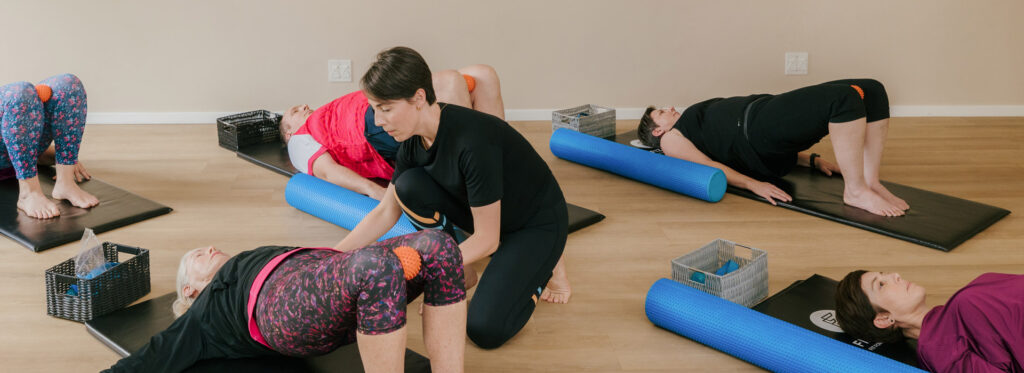
These exercises follow MAP’s core principles: breath first, slow tempo and good positions over big numbers. Most are floor-based, so grab a mat (or a rug), a foam roller if you have one, and wear something comfy. Do each one for the suggested reps, moving slowly enough that you could describe what you’re feeling as you go.
The tempo rule
Count 3 seconds into each movement and 3 seconds out. If that feels painfully slow, you’re doing it right. Slow movement gives your nervous system time to find the right muscles instead of letting momentum do the work.
1. 90/90 breathing (2 minutes). Lie on your back with your calves resting on a chair or couch so your hips and knees are at right angles. Place your hands on your lower ribs. Breathe in gently through your nose and feel your ribs widen sideways, then exhale slowly through pursed lips as if blowing out a candle. Feel it: your ribs softening down and your back settling into the floor. Easier: feet flat on the floor instead.
2. Pelvic clock (8 slow circles each way). Lie on your back, knees bent. Imagine a clock face on your lower belly. Gently tilt your pelvis towards 12 (back flattens), 3, 6 (small arch) and 9 in a smooth circle. Feel it: your lower back starting to move in a more relaxed way. Easier: just rock between 12 and 6.
3. Glute bridge with a ball squeeze (10 reps). Lie on your back, knees bent, with a soft ball or folded cushion between your knees. Breathe out, squeeze the ball gently and peel your spine off the floor one segment at a time until your hips are lifted. Roll down slowly. Feel it: your bottom and inner thighs working, not your lower back. Harder: pause for 3 breaths at the top.
4. Dead bug (6 to 8 per side). Lie on your back with arms reaching to the ceiling and knees bent at 90° above your hips. Breathe out and slowly lower your right arm and left leg towards the floor, keeping your lower back gently in contact with the mat. Return and switch. Feel it: deep belly muscles bracing like a gentle corset. Easier: move only the legs, tapping a heel to the floor.
5. Side-lying open book (5 per side). Lie on your side with knees bent and stacked, arms straight out in front. Breathe in, then as you breathe out, sweep your top arm up and over to the other side, following your hand with your eyes, so your chest opens to the ceiling. Feel it: your upper back rotating and your chest opening. Easier: place a pillow under your head.
6. Upper back release on the foam roller (1 to 2 minutes). Lie with the roller under your shoulder blades, hands supporting your head. Gently extend over the roller, then move it a few centimetres and repeat. Stay off your neck and lower back. Feel it: your upper back loosening and your chest lifting. Our 4-week myofascial release workout plan has many more release techniques if you enjoy this part.
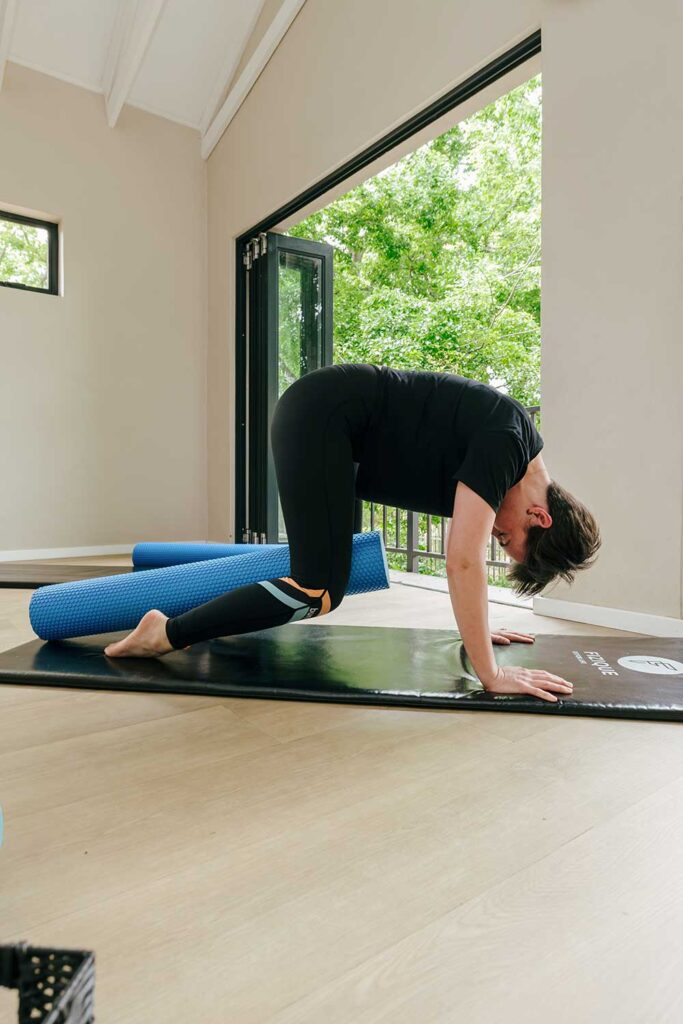
7. Quadruped rock back (8 reps). Start on hands and knees, hands under shoulders and knees under hips. Keeping a long, neutral spine, slowly rock your hips back towards your heels as far as is comfortable, then return. Feel it: your hips moving while your back stays calm and steady.
8. Bird dog (6 per side). From all fours, breathe out and slowly reach your right arm forward and your left leg back, keeping your hips level, as though you have a cup of tea balanced on your lower back. Hold for one breath and return. Easier: slide just the leg back along the floor.
9. Thread the needle (5 per side). From all fours, slide your right arm under your body towards the left, letting your right shoulder and ear lower towards the mat. Breathe into your upper back, then unwind and reach the arm up to the ceiling. Feel it: a lovely twist between the shoulder blades.
10. Half-kneeling hip flexor reach (3 breaths per side). Kneel on your right knee (on a cushion) with your left foot in front. Gently tuck your tailbone under until you feel a stretch at the front of the right hip, then reach your right arm up and slightly over to the left. Feel it: a long line of stretch from the front of your hip up the side of your body. Great for anyone who sits a lot.
11. Wall slides (8 reps). Stand with your back against a wall, feet a small step away. Bring your arms up in a “goalpost” shape with the backs of your hands near the wall. Breathe out and slowly slide your arms up as far as you can without your lower back arching away from the wall, then slide them down. Feel it: muscles between your shoulder blades working and your chest opening.
12. Posture-reset sit-to-stand (8 reps). Sit near the front of a sturdy chair, feet hip-width apart. Lengthen through the crown of your head, breathe out, press your feet into the floor and stand up without using your hands. Sit down slowly, taking 3 seconds. Feel it: legs and glutes doing the work while your posture stays tall. This is one of the most useful real-life exercises there is, especially as we age.
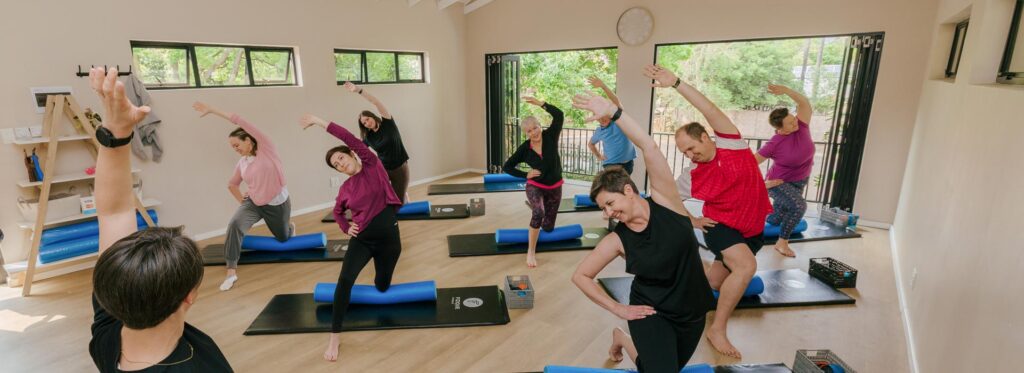
Brand new to all of this? Start with our four beginner MAP exercises for home before moving on to the full list.
Here’s a gentle way to start. Each session is short enough to fit around work and family, and the rest days are part of the plan, not a sign of laziness.
| Day | Week 1 (about 15 min) | Week 2 (about 20 min) |
|---|---|---|
| Monday | Exercises 1 to 4 | Exercises 1 to 6 |
| Tuesday | Rest or a 20-minute walk | Rest or a 20-minute walk |
| Wednesday | Exercises 1, 5, 6 and 7 | Exercises 1 and 5 to 10 |
| Thursday | Rest or a walk | Rest or a walk |
| Friday | Exercises 1, 8, 11 and 12 | All 12 exercises, one round each |
| Weekend | 2 minutes of 90/90 breathing each day | Your favourite 3 exercises plus breathing |
Want to do even more on rest days? Walking is the perfect partner. The World Health Organization recommends that adults get at least 150 minutes of moderate activity a week, plus muscle-strengthening work on at least two days (WHO physical activity guidance). Three MAP sessions and a few brisk walks will get you a long way there.
This is the question everybody asks, and it deserves an honest answer rather than a sales pitch. Everyone is different, but here’s a realistic picture:
The secret ingredient is consistency. Two or three sessions a week, every week, beats an enthusiastic burst followed by a month off. Wondering what all this adds up to? Here are the key benefits of Myofascial Activated Posture for alignment.
Often, yes. Gentle, controlled movement is usually better for back pain than rest. But “serious back problems” can mean anything from a stiff lower back to a recent disc injury or spinal surgery, so the right approach depends on you.
Here’s how we’d approach it:
For a full routine designed with sore backs in mind, see our best MAP exercises for back pain relief. The NHS also has helpful guidance on common posture mistakes and how to fix them.
A quick safety note
If you’re pregnant or postnatal, recovering from surgery, or managing osteoporosis, heart or lung conditions, check with your healthcare provider before starting a new exercise programme. Many of these exercises can be adapted. They just need the right tweaks for you.
You’re not alone. Many people arrive at their first MAP class having been put off exercise by a class that was too fast, too crowded or too “no pain, no gain”. Common stories include an instructor who never noticed a struggle, a pace that made it impossible to keep good form, or being pushed through pain and then paying for it for a week.
If that sounds familiar, here’s what to look for in any class, MAP or otherwise:
That’s how our classes are built: small groups of no more than 10 people, led by a registered physiotherapist and an experienced MAP trainer. If you’re nervous, start with a private session and move into a group once you feel confident. You might also enjoy reading about the mind-body connection in MAP movement. It explains why the slower pace makes such a difference.
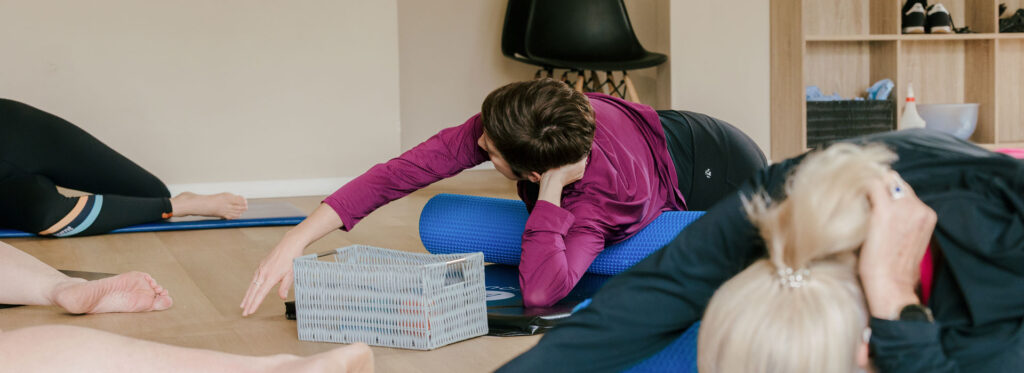
Home practice is wonderful, but there’s nothing quite like having a trained eye on your movement, especially in the beginning. Little adjustments, like a slightly different foot position or a softer breath, can completely change how an exercise feels.
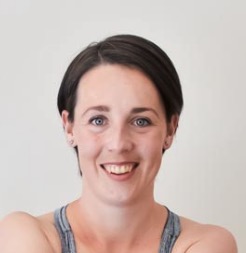
You can check class options on our price list, and read more about Martina Johannes, registered physiotherapist.
Ready to try MAP with expert guidance?
Whether you’re starting fresh, returning after pain or simply want to move better, we’ll help you find the right starting point.
In movement and rehabilitation, MAP stands for Myofascial Activated Posture. It’s a method that combines controlled breathing, fascial release with simple tools and slow, intentional movement to improve posture and mobility. (Elsewhere, MAP can also mean mean arterial pressure, a blood pressure measurement, which is unrelated.)
Mostly, yes. Much of a MAP session takes place on a mat, lying down or on hands and knees, which takes pressure off the joints and makes it easier to focus on control. Sessions usually finish with kneeling and standing movements to carry the benefits into everyday life.
Many people feel calmer and looser after their first few sessions. Noticeable, lasting changes in mobility and posture usually take 4 to 8 weeks of practising two to three times a week, with strength and control continuing to improve over the following months.
Yes, for most older adults. MAP is low impact, can be done mostly on the floor or with a chair, and is easy to adapt. It also supports the strength, mobility and balance that help prevent falls. If you have osteoporosis, heart or lung conditions, or balance problems, speak to a health professional first so the exercises can be adapted.
Often, but get assessed first. A physiotherapist can identify which movements suit your condition and which to avoid for now. Start with gentle breathing and small movements, and seek help promptly if back pain comes with leg numbness or weakness, bladder or bowel changes, or fever.
Not to start. A mat or rug, a cushion and a wall are enough for most of the exercises in this guide. A foam roller, a trigger point ball and a looped resistance band are helpful additions as you progress.
Two to three sessions a week is ideal for most adults, with walking or other light activity on the days in between. Short daily breathing practice is a great bonus.
No, although they share some ideas, such as breath, control and body awareness. MAP puts a particular focus on the fascial system, using release tools and posture-based activation. Many people enjoy combining MAP with yoga or other exercise.
Sources
This article is general information and isn’t a substitute for a personal assessment. If you’re unsure whether these exercises suit you, speak to a physiotherapist.